Tuesday, April 16, 2013

Laura and Shane


Practical weekend


Friday April, 12th 2013


Day one of our practical weekend! The weather was gloomy and wet, and the grounds at the cuddy gardens were terribly squishy and swampy.

We arrived at 7:45 am and waited for Lucas to arrive and open the classroom, once we were in the class we all gathered around for Lucas to give us our duties for the weekend. There are three groups here this weekend so the morning started off a little bit slow.

Lucas walked Shane and I around the areas we would be working on and explained what he wanted us to do over the weekend, I took notes to ensure we wouldn’t forget anything.

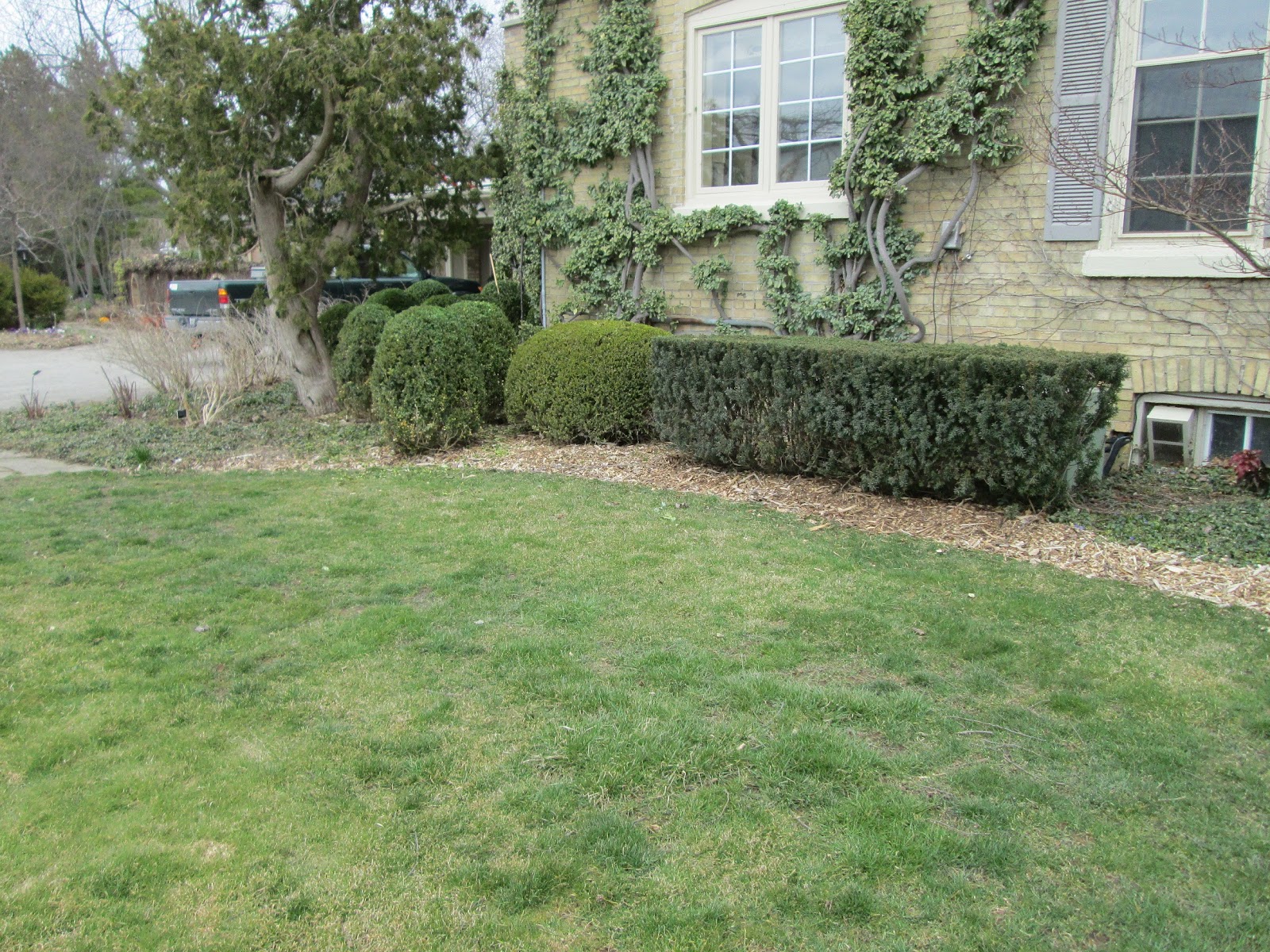
Once he finished giving us our tasks, Shane and I went to the tool shed to get some loppers and hedge trimmers to begin pruning the Yew hedge on the outside of the prairie border which took us the remainder of the morning.


After lunch Lucas took Shane and I to the area where the new compost bin is being built and showed us what we would need to do to assemble it. He helped us for the rest of the afternoon and we got it nearly finished, only had a few more boards to add on Saturday.

We cleaned up, signed out and headed home for the night, tired but satisfied with the work we accomplished.


Saturday April, 13th 2013


Day two and the weather wasn’t much better than it was on Friday, dark and rainy again, seemed like the sun was trying to come out in the morning but didn’t stay too long. We arrived at 7:45am and signed in.

I started the day by pruning the boxwood in the prairie boarder, using the DDD method (dead,dying,damaged) and trimming off as much of the boxwood miner and psyllid, and anything that looked unsightly. While I was pruning Shane was raking out prairie border to try to get out some of the pods that make the garden look messy.


Shane also dug up some Kerria Japonica ‘plendiflora’ suckers and we gave them to the greenhouse weekend students to be potted.

We picked up the piles of debris and put them in the trailer, we then moved over to the gardens across from the car port and pushed any mulch that had come down onto the drive way back into the bed, and went through the garden and pulled out any large branches by hand. We continued this routine all the way along the length of the bed until lunch time.


After lunch the weather seemed to improve and the sun even managed to come out! So Shane and I went back over to the compost bin and continued to attach the boards to the posts. We ran into a couple of problems with boards being too small and some uneven seems but managed to cut some extra boards and it all looks great!


Once we finished that we went over to the dry garden and I began to fan rake all the debris out of the paths and Shane filled the RTV bucket with pea stone and brought it over to the dry garden.

Once Shane dumped the stone down on a tarp he began to help me rake the pathways which took us to the end of the day, we cleaned all our tools and put them back in the tool shed.

Another successful work day!

Sunday April, 14th 2013


Today was a much better day in terms of weather! The sun is out and shining and the temperature was quite warm. We arrived at 7:45am and signed in as a group.

We were assigned the task of edging the prairie boarder and the garden by the road but unfortunately the weather over the weekend caused the ground to be very soft and mushy, so when we attempted to edge it was just a mess, so we decided edging would do more harm than good.

Shane and I started off the morning by setting up the string lines in the dry garden so we could begin straightening the stone borders around the garden beds.


We set the lines and then straightened any stones that were out of line, we had some trouble every now and then getting the string line right but we did our best and continued to straighten as much as we could. Around 2:30 we filled the back of the RTV with pea stone and brought it to the dry garden. We spent the rest of the afternoon raking gravel along the dry garden to even out any low spots.

At 4:15pm we took down the string lines and packed up and took all of our tools and equipment back to the shed to be power washed. We put everything back where it belonged and did a walk around to make sure we didn’t forget anything, and came to the classroom to sign out for the night.

We had a very productive weekend, we hit some challenges but did our best to over-come them! All and all we had a very successful and educational weekend!


Plant Profile

Laura Hill & Shane Sofia

Weekend Practical Assignment

April 12-14/2013


Botanical name: Hamaelis x intermedia ‘Primavera’


Common name: Primavera Witchhazel


Family: Hamamelidaceae

Genus: Hamamelis

Species: × intermedia

Cultivar: 'Primavera'

Category: Woody

Type: Shrub (deciduous)

USDA Hardiness Zone(s): 5-9

Source: http://www.plantdatabase.co.uk/Hamamelis_x_intermedia_Primavera

Origin: Asia

Height: 2.4 – 3m

Spread: 90 – 120cm

Temp (C): - 28

Temp (F): - 18

Habitat: Horticultural origin.

Growth: Slow growth habit

Flowering Period: February to March

Landscape Use:

• Accent

• Mass planting

• Borders/hedges

• General garden use


Propagation:

• Cultivars are usually grafted


Shape:

• Upright and spreading

• Slightly rounded

Cultivation:

Pests:

• Deer Resistant.

• Japanese beetle, chews on the foliage in specific areas.

• Occasional galls appear on foliage.

Notable specimens: A.M Cuddy Gardens, Strathroy, Ont.

ID Characteristic:

• Upright/spreading from.

• Grey/greyish-brown bark.

• Smooth textured.

• Large yellow late winter/ early spring flowers.

• Capsule like fruit.

General Description:

• Multi-stemmed.

• Large deciduous shrub/small tree.

• Flowers in late winter/ early spring.


Flower Description:

• Long/ narrow petals.

• Spider-like.

• Flowers will open and close depending on weather conditions.

• Long lasting flowers.

• Pale yellow flowers that bloom from February- March.

• Fragrant.

Bark Description:

• Smooth textured.

• Grey, greyish-brown.


Leaf Description:

• Alternate/simple leaves.

• Leaves are droopy, grey-green colour.

• 7.6cm – 15.24cm

• Foliage has a ripple-like texture.

Texture Description:

• Smooth textured bark.

• Soft textured leaves with a ripple-like pattern.


Colour Description:

• Leaves are greyish-green in spring and red/yellow in autumn.

• Grey/greyish-brown bark.

• Yellow petals on flower.

Bud Description:

• Buds are bare (naked).

Fruit Description:

• Does not have major ornamental importance.

• Capsule shaped and black


Works cited

"Hamamelis X Intermedia." - Plants in Profile. N.p., n.d. Web. 13 Apr. 2013

"Hamamelis X Intermedia Primavera." Hamamelis X Intermedia Primavera. N.p., n.d. Web. 14 Apr. 2013.

"Hamamelis X Intermedia 'Primavera'" Plant Database RSS. N.p., n.d. Web. 13 Apr. 2013.

“Hamamelis X Intermedia 'Primavera'" (Witch Hazel 'Primavera'). N.p., n.d. Web. 14 Apr. 2013.

" WSU Clark County Extension." Primavera Witchhazel. N.p., n.d. Web. 14 Apr. 2013


Nate Mckim and Nick Gleba April 12-14


By Nate McKim


Hey everyone! Fanshawe horticulture student Nate McKim here. It’s great to be back at Cuddy’s! Having worked here all last summer, this place grew on me quite a bit, but I don’t think I fully realized how much until I started getting my hands dirty again in the garden beds, and riding around on the tractors. The weather might not have always been on our side during this weekend but as any gardener in Canada knows; there’s nothing quite like working in the great outdoors no matter what the weather, to shake off the boredom and anxiety that can set in from long cold months of frozen ground and inactive gardening tools. With Mother Nature a little on the fence about what kind of weather she felt like throwing our way, we would definitely have our work cut out for us.

Friday found us knee deep in mud and soaked through to our long johns. (Whether or not anyone else but me was actually wearing long johns is past my knowledge and clearly none of my business) With very little gardening to be done due to the nasty rain, we turned our attention to renovating the composting system. Here at Cuddy’s, the three R’s are of pivotal importance. In this disposable society, making the most of what you have (or what you’re fortunate enough to get your hands on) can often lead to very interesting and functional garden projects. Our task was to construct a new compost bin that would be large enough to hold the hefty amount of garden waste produced here on a yearly basis and sturdy enough to last the test of time. By salvaging a good load of used posts and boards from an old horse fence from the neighboring farm (score!) we were able to achieve this. Nick and I spent the day hauling these boards around, predrilling and cutting them to size, and delivering them to the installation team of Shane, Laura and head gardener Lucas. The result was a functional, cost effective and pretty fine looking compost bin.


With the weather looking more agreeable on Saturday we began to set our sights on some gardening work that would keep us off the very saturated turf while still accomplishing some much needed spring maintenance. Nick spent the day pruning the euonymus growing up the sides of the house on the main level
while I spent a not so relaxing day on the patio (cocktail free of course) doing a thorough spring maintenance. Over time the patio’s English ivy becomes quite intrusive and needs to be cut back to re-define the hardscapes.
Unfortunately the Boxwoods had developed a rather bad case of Boxwood Leaf Miner and needed to be sheered back to maintain form and to assert a physical control method on the miner.
 Other shrubs and perennials such as Lavender and Pineapple Mint also required pruning back to encourage a new season’s growth.
With the waterfall acting as a soothing soundtrack of nature, this patio is about ready for some soon approaching summer enjoyment.

The weather finally takes a turn for the better! Even with saturated turf and garden beds, there is still much work to do on Sunday at Cuddy’s. Nick spent his time today tidying up the Prairie Border and helping me clean up the mess I made. The mess in question is a result of the pruning that I was doing around the houses garden beds. This included sheering back all the Boxwoods to a nice compact form, hitting back the Spirea’s for a new seasons growth, maintaining the forms of the Yews and euonymus and some general maintenance pruning to Dogwoods and other shrubs as well as finishing the pruning of the euonymus on the house.

 Starting the spring maintenance around the house is usually a good idea and nice central place to start your gardening. As the weather continues to change for the better, you can continue to move outwards and explore the rest of your gardening spaces and possibilities.

That’s all for now! Just remember, no matter what weather is thrown at you in the spring, no matter how knee deep in mud you may be or no matter how saturated your long john underwear may become, there is always gardening work to be done and good excuses to get outside. So get out there and get growin’! In closing, here’s a good plant selection for awesome early spring blooming when Mother Nature’s got you down with all the April showers.


Erica carnea


‘Pink Spangles’


By: Nate McKim


Botanical information:


Family: Ericaceae

Genus: Erica

Species: carnea

Cultivar: 'Pink Spangles'

Category: Woody

Type: Shrub (evergreen)


Details:


USDA Hardiness: 5 to 7

Canadian Hardiness: 5

Temperature: -23 to -26 Degrees Celsius

Height: 30 cm

Spread: 60 cm


Description and Growing Information:


Landscape: Works very well in a rock garden situation or as a spreading groundcover.


Propagation: Best propagated by semi-hardwood cuttings


Habitat: Central and southern Europe.


Shape: Low and spreading.


Growth: Slow.


Flower period: Late March to early April.


Cultivation: Prefers moist, acidic and very well drained soil that is low in fertility yet high in organic matter


Pests/ diseases: May be susceptible to some fungal diseases; however this is rare as pests and diseases are usually not an issue with this plant.


General Description: Very low and wide spreading plant with evergreen foliage and showy colourful blooms.


Flower description: Flowers are very small, cylindrical and borne in four sided racemes. Pink in colour and very showy in the spring.


Leaf description: Leafs are needle like 3 to 6 cm long with a bright evergreen colour. Leaves have very small petioles, are whorled to opposite and have margins that are turned under.


Texture description: Fine


Bark Description: No ornamental significance


Colour description: Evergreen foliage with bright pinkish red blooms in the winter and early spring.


Fruit Description: Small ornamentally insignificant dehiscent capsules containing many small seeds.


I.D. Characteristic: Showy pink blooms that are a wonderful spring bee attractant.


Notable specimens: The A.M Cuddy Gardens, Strathroy Ontario.


References:


http://canadaplants.ca/display.php?id=3732


http://canadaplants.ca/display.php?id=79


http://apps.rhs.org.uk/plantselector/plant?plantid=2876


http://www.hort.uconn.edu/plants/e/ericar/ericar1.html

Tuesday, April 9, 2013

Randi and Doug's weekend

Spring 2013, April 5th-7th 2013.


Randi Brooks and Doug Lawler


Friday April 5th, 2013


Spring has arrived at Cuddy Gardens and now it is time to prepare the lawn by removing thatch and spreading compost soil. For the first part of our morning we were doing just that- spreading a layer of compost soil around the brick work in the ground at the front of Cuddy gardens. After lunch we helped Lucas start building a new compost bin. It is much larger than our last one. When the posts were up for the compost bin we then went over to help the other group of students lay sod down.

Saturday April 6th, 2013


Since spring is here, we had to take down and roll up all the snow fence, as well make sure there were no more posts in the yard from snow fence that had already been taken down. We took down all the burlap around the trees in the rose garden and raked up the bean pods near the drive way. We also collected all the rodent traps and cleaned them out and packed them away for next winter.


Sunday April 7th, 2013


Sunday was a day full of mulching. We mulched the woodland garden and made the paths a little larger. We also raked and picked up any large sticks or debris off the lawns. We power washed all the tools are machinery so that they are nice and clean for the next class. Randi’s dog Ashby came for the day and had a great time.


Plant Profile


Helleborus orientalis

Lenten Rose

Family- Ranunculaceae

Genus- Helleborus

Species- orientalis

Common Name- Lenten Rose

Category- Perennials

Type- Herbaceous Perennial

Canadian Hardiness Zone- 4 to 9

Landscape- Group in woodland gardens, shady locations or incorporate into a naturalized area.

Native- Notheastern Greece, Northeastern Turkey.

Habitat- Woodlands

Growth- Slow

Flowering period- March to May

Propagation- By seed or vegetative propagation

Light requirements- Part shade to full sun

Water requirements- Medium

Flower description- Showy pink/purple flowers

Leaf description- Deep green leathery green basal leaves.

Pests- Not affected by many pests.

Notable specimen- Cuddy Gardens in the woodland garden.


References


"Gardening Help." Missouri Botanical Garden. N.p.. Web. 7 Apr 2013.
Brickell, Christopher, and H.Marc Cathey. A-Z Encyclopedia of Garden Plants . New York, NY: DK Publishing INC, 2004. 509-510. Print.

April 5-7 2013


Holly Trozzo and Aaron Shubrook arrive at the A.M. Cuddy Gardens, and team up for some heavy duty yard chores!

FRIDAY – April 5

We began our first task of the weekend, which was to fill, compact and grade an area of the ditch at the front of the property to allow cars to park on the lawn. We used up the excess soil from the newly planted cedar windbreak by loading it into the Kubota tractor bucket by hand, unloading it onto the specified area, spreading it with a rake, and compacting it with a hand tamper every few inches.


“Why don’t you compact it with the tractor?” says Michael Pascoe, “That’s what I would do.”

So we did:


Buckets and buckets of soil went into this area, compacted again and again until the final grade was made. Next - we cover it with sod!


SATURDAY – April 6

As the sodding continued, we were very grateful and fortunate that the forecasted rain held off so as not to make this heavy job even heavier.


A second Kubota tractor with trailer was signed out today, and we used this to begin our second large task of removing all of the brush piles laid around the property. As a team, Aaron and I would load the trailer to a towering height and tie it down with rope for transport. Thanks to last semesters Arboriculture class, we were both quite proficient in tying quick knots.

We took turns driving the tractor out to the burn pile; while I drove the beautiful,scenic drive to the burn pile, Aaron continued on with the sodding as he’d had previous experience in the task and could complete it quicker than I. While Aaron drove to the burn pile, I collected large sticks from the front lawns and garden beds, raked and cleaned up the very front lawn where the majority of the pruning took place and the largest brush piles were.

– BEFORE

– AFTER

SUNDAY – April 7

Today the rest of the brush was removed to the burn pile. As a courtesy to our neighbours here at the Cuddy Gardens, on our final trip to the burn pile we picked up the sticks that had jostled themselves loose on all the previous trips on those roads.

Unfortunately we were unable to complete all of our sod duties for this weekend, but we composted the majority of the remaining sod as instructed, leaving enough to complete the few areas we had left.

The rest of our day was spent raking the lawns of large debris (tricky..with the strong wind against us) and cleaning off the hard surfaces around the property.

To end the weekend, all equipment was cleaned off well with the power washer and returned to the tool shed in its proper place.


Our plant profile is for Crocus x ‘Yellow Man’


Family: IRIDACEAE


Genus: Crocus


Cultivar: x ‘Yellow Man’


Common Name: Yellow Man Dutch Crocus


Category: Bulbs


Type: Perennial


Canadian Hardiness Zone: 4-9


Landscape: One of the first in any landscape to bloom, it is planted to add colour.


Native Range: Southern Europe and the Alps


Growth: Fast


Flowering Period: March to April


Propagation: By division or sow seeds outdoors in the fall.


Light Requirements: Full sun to dappled shade.


Water Requirements: Moderate


Flower Description: Flowers are oval, open in the sun, and close when the weather is dull.


Leaf Description: Leaves are long and thin, bearing a pale green or white stripe down the centre.


Colour Description: Dark Yellow to orange yellow


Cultivation: Grow in full sun to dappled shade with a well-drained soil.


Pests: Birds, mice or other small rodents may eat the corms. Prone to rot or mold if storing.

References: http://www.almanac.com/plant/crocuses, http://www.finegardening.com/plantguide/crocus-vernus-cvs-dutch-crocus.aspx, http://northernshade.ca/2010/04/21/crocus-vernus/

Tuesday, April 2, 2013

Spring 2013, March 29-31 Blog


Tami Gillespie & Brandon Robidoux

Friday, March 29, 2013

Our Easter morning practical began with the opening and cleaning out of the poly houses. Filled to almost full capacity were potted Thuja occidentals (White Cedar). Clearing out these cedars was the first step to preparing the poly house for spring and the growing season. Throughout the cold winter months the cedars had become very dried out and required water ASAP. We spent majority of the morning taking the cedars out of the poly house, lining them up in rows between the two poly houses and irrigating them. Right before noon the famous Mr. Mike Pascoe and his dog BD stopped by to visit us. By then the cloudy morning had turned into a bright sunny day perfect for working in. After discussing with Mike the progress of the poly-house clean up, we went for a walk to determine the rest of the task assigned to us for the weekend. The main priority for our weekend practical is the continuation of the spring clean-up of the Cuddy A.M Gardens, specifically the grasses and flower beds in front of the Cuddy hatchery. Tall perennial grasses had been left standing for winter interest. But with spring well upon us it was time to cut them back. The flower beds were in need of some detail clean-up as they were littered with leaves, dead foliage and the occasional weeds. Due to the frontal location of the hatchery located along the Cuddy Gardens entrance driveway it was imperative that the gardens beds are kept to a pristine level of excellence. We continued to relocate Cedars and irrigate them for the remainder of the day. Thoroughly sweeping out and tidying up was the last task completed.


Empty Poly-houses


Relocated Thuja occidentalis

Saturday, March 30, 2013

Arriving at the Cuddy Gardens Saturday morning, we were fully prepared to load up the RTV with every kind of maintenance tools available to us and head out to work on the spring clean-up of the front garden beds. After circle checking all the equipment to ensure they were operating properly and double checking we had all the tools needed for the day. We set out to hook up the trailer to the tractor. That’s when a positive morning turned sour. Despite perfectly lining up the tractor ball to the hitch on the trailer, we discovered that we could not securely latch the hitch together. 30 minutes, a phone call to Lucas, and some creative hammering we finally managed to completely secure the trailer. Hoping not to lose any more time, we parked the tractor and trailer close enough to garden beds for ease of debris removal. We thought it would be as a simple task to tie up the grasses and shear them down with hedge trimmers. However our bad luck continued; discovering that the gas cap on the hedge trimmer was broke. We feared that the task of cutting down the grass in a few hours by gas powered hedge shears would turn into a whole day of hand cutting them. Thankfully, Lucas was a simple phone call away he suggested a creative solution. Borrowing a gas cap from another machine made by the same company allowed us to use the gas powered hedge shears safely with no more fuel leaking. Despite the setbacks, only an hour of work was lost and a cold morning turned into another beautiful spring day perfect working weather. The rest of our morning passed by quickly, with no more sign of bad luck. Working together we planned a systematic pace of tying the grasses, cutting them, raking up the dead foliage, weeding and sweeping the pavements. Mounding each grass is important for structural growth. Before noon hit we had half the grasses cut back. Early afternoon Mr. Mike Pascoe popped up again asking “What up?”, and how we were doing. He check our work was completed to “Horticulture Standards” and left us to continue working. We then continued to cutting back more grasses, dump the spent grass foliage in the burn pile and raking out the grass beds. Planted along with the grasses were some Cotinus (Smoke Bush) we pruned them down to 4-5 buds using the coppicing technique to encourage “suckering” and lateral growth. As the day continued the wind became an issue. It would die down while we were raking the grass foliage and picked up again blowing our neat piles of collected grasses everywhere. The last task tackled before leaving was the removal of the snow fencing. Even with wire cutters, it was troublesome to remove the fence from the t-bars but the task was accomplished.


Uncut grasses, cut back grasses

Sunday, March 31, 2013

Our last day of weekend practical continued with cutting back the last section of perennial grasses remaining. Unfortunately April was right around the corner and with that comes spring rain. Not enough rain to make garden maintenance miserable, but steady drizzling turned the dry garden beds into a muddy mess. Due to the weather cleaning up the beds was slow progress. The wet grass just seemed determined to remain in the garden beds, our work boots became caked with mud, and the RTV and Kubota began leaving muddy tracks. Despite the weather Mr. Pascoe and his dog BD dropped by again to review our progress. He suggested using a snow shovel to remove the tracked mud. The rain persisted until just after lunch, perfect timing for us to finish cleaning up the driveway unfortunately due to the wet weather we weren’t able to back-pack blow the driveway clean. Next on our to-do-list, a task we were both dreading was the clean-up of the Berberis (Barberry) hedge located along the Cuddy Hatchery. Over the fall and winter months the dormant Berberis has become littered with leaves. Berberis is a thorny deciduous shrub that grows on dead wood. Wearing thick gloves, with weeding buckets in hand we set out to clean up the hedge to a zero leaf left. The task took less time than expected and our cloudy day surprisingly turned to sunny. The corners of the gardens proved most difficult due to the planted Cotoneaster its trailing form was perfect for leaves to become entangled and caught within. We finished up the day with tying up any leave left on the driveway. We made one last trip to both the compost area and the burn pile. We then power washed all tools and equipment.

Our plant profile was on Galanthus nivalis (Common Snowdrop)


Plant Profile for Galanthus nivalis

Family: AMARYLLIDACEAE

Genus: Galanthus

Species: nivalis

Common Name: Common Snowdrop

Category: Bulb, Perennial

Type: Spring Flowering Bulb

Canadian Hardiness Zone: 3 to 7

Landscape: Mass plantings, woodland gardens, under large deciduous trees. Also effective in groupings in rock gardens, border fronts, in front of flowering shrubs or along walks or paths. Mix with other early flowering bulbs such as Eranthis (Winter Aconite)

Native Range: Europe

Habitat: Woodlands

Growth: Fast

Flowering Period: March and April

Propagation: Division can be made when bulbs are in full foliage or when they are dormant in late summer. Allow foliage to die back naturally.

Light Requirements: Full sun to part shade.

Water Requirements: Medium.

Flower Description: 3 large white petals, 3 similar sepals on inside of flower. Flower bearing stock is 7-15 cm in length with a single erect bud. Flowers will eventually die down to soil level.

Leaf Description: Smooth and semi-glucose, dull grayish-green in colour. 5-15 cm in length when in flower. 0.4-0.8 cm in width. Each bulb produces 2-3 narrow, linear, basal leaves.

Colour Description: White pendulous flowers with light green leaves

Cultivation: Easily cultivated in most free draining soils. Low maintenance bulb

Pests: No serious insect or disease problems

References

http://www.canadaplants.ca/display.php?id=1209

http://www.missouribotanicalgarden.org/gardens-gardening/your-garden/plant-finder/plant-details/kc/k300/galanthus-nivalis.aspx

Tuesday, March 26, 2013

Emilio and Pedro's Weekend March 22-24 2013

Emilio and Pedro’s Weekend Practical

This weekend was a great weekend to get spring cleaning started at The A. M. Cuddy Gardens. On Friday it was awesome as  we got to cut down a diseased spruce and a diseased Norway maple with none other than amazing Lucas ‘Destroyer of Trees’ (Only invasive or diseased trees though)!


For the people that frown on trees getting cut down we are planting a wind break with Serbian spruce where the Norway maple (an invasive species) was. On the Saturday we started to cut back perennial grasses and hydrangeas.


When we were doing the grasses, we found some voles hiding underneath the grasses and we attempted to relocate  them but they were too fast for us. The hydrangeas we cut back were Hydrangea arborescens 'Annabelle' we left the first bud so they can have the chance of producing a great bloom for the summer. We also pruned the 2 Physocarpus opulifolius ‘Diablo’ one of the ninebarks was massive, we probably took out a third of this ninebark and it still looks like a fully grown plant.

Sunday we enjoyed a day of cleaning the mess we made Saturday and removing snow fencing from around the gardens!

We are so glad this is a late spring; this year our magnolias won’t lose their flower buds to a late frost. Come and check them out this summer during the open house! Guided tours with my idol  and plant guru Michael Pascoe and  an amazing plant sale! You never know what you’re going to find!

Anyways, That was a quick wrap up of our weekend! We are making like a tree and leafing “bad joke” Take care!


Plant Profile for Hamamelis x intermedia ‘Jelena’


Family : Hamamelidaceae

Genus : Hamamelis

Species : x intermedia

Cultivar : ‘Jelena’

Category : Woody

Type : Shrub (deciduous)

Source :
Landscape: A class shrub used as a late winter flowering shrub for winter interest in a shady location. Also used for its fall foliage.

Habitat: Horticultural origin.

Shape: Broad-crowned, multi-stemmed with an open habit. 4 m x 4 m

Growth: Medium

Flowering Period: February March

ID Characteristic: Open shape, first woody plant to flower.

General Description: A broad crowned large shrub, blooming with orange/dark orange flowers during winter.

Flower Description: Each flower has four slender strap-shaped petals 1–2 centimetres long, dark orange to orange. Fragrance similar to orange soda such as C-Plus.

Leaf Description: Alternately arranged, oval, 4–16 centimetres long and 3–11 centimetres broad, with a wavy margin.

Texture Description: A fine textured, sprawling shrub with an open form.

Colour Description: Summer foliage is bright to dark green and Autumn foliage is clear yellow

Propagation: Graft cultivars in late winter or bud in late summer.

Bud Description: The buds are naked and densely pubescent.

Bark Description: Smooth grayish

Fruit: 1 cm to 1.5 cm long capsules that ripen in 1 year and are expelled explosively from the capsule.


Cultivation: Grow in fertile, moist but well-drained soil, in full sun or partial shade in a site that is open but not exposed.

Pests: Honey fungus and coral spot may be a problem

Notable Specimens: A.M. Cuddy Gardens, Strathroy , Ontario


Work Cited

http://www.rhs.org.uk/Gardens/Hyde-Hall/About-HydeHall/Plant-of-the-month/January/Hamamelis-x-intermedia--Diane-

Type o on Canada plants http://www.canadaplants.ca/display.php?id=398

http://www.hort.uconn.edu/plants/h/hamvir/hamvir1.html


Monday, November 5, 2012

November 2nd – November 4th, 2012


FRIDAY

Well, how goes it everyone? Today was certainly not good for Devin and I (Eric) as the weather seemed to have a mind of its own bringing flurries, wet snow, rain, sun and even HAIL at one point!


We started our day by first identifying the dead and broken branches located in the backdrop of the Hosta Garden, using pole saws, hand saws and secateurs to remove them as neatly as we could. In order to keep our work area neat, we piled the cut down brush in areas that we were already finished in order for easy and efficient removal later on in the day. After and although it was extremely wet and cold out, Lucas our on-site staff, Devin, I and even Mr. Pascoe came to help us as we hammered away at nails putting white poly on one of the two Hoop Houses we have here at Cuddys Farm. Once the hoop house was taken care of, we than started removing steel panels from an area in the Hosta Garden and placing them at the North end corner of the sea container. After that was done we thought we were in the clear just having to mulch all afternoon using the mower and trailer! Although due to the muck and very wet areas we could not dump mulch near our spreading area causing it to be quite difficult to get large mulch piles anywhere, just wheelbarrow loads. The area was also quite larger than what we had expected so we could only finish mulching the one half of the Hosta bed and the pathway amongst them.

SATURDAY

Up for a bright and early rainy morning on Saturday, Devin and I arrived to Cuddys with a new list of tasks for the day while still continuing to deal with mulching. Unfortunately, the ground was still absolutely flooded and mucky everywhere so we were still having a hard time dumping the trailer. Splitting up, Devin continued the toughest task of dumping wheel barrow loads all day, while I removed the leaves from small perennials in the Magnolia Garden, cut back Hostas using secateurs and shears, pruned the dead out of trees with a pole saw in the Woodland Garden, power blew larger leaves off of the plants as well to avoid smothering and bailed water out of the water trough using a bucket.

SUNDAY

Another bright and early day, today consisted of no rain although the ground was still fairly wet and we both were still unable to get the trailer where we wanted in the Hosta Garden. At this point we had become one with the pitchfork and wheel barrow and dumped loads all day, spreading with a hard rake once enough was down. We hauled any debris or limbs that were still piled up under the trees and moved them to the North West corner which is to be chipped up into mulch later on. Devin continued to dump wheel barrow loads of mulch for an hour or so as I completed watering the hoop houses and blowing off all hard surfaces on the Cuddys property. Mulching was not completed as a small area is still left but all piles were spread and cleaned up before we left the site. All tools as well as machinery we had used throughout the weekend was power washed off before we left.

Plant Profile

A plant we learned was Heuchera ‘Mint Frost’.

Common name: Mint Frost Heuchera or Mint Frost Coral Bells

Family: Saxifragaceae

USDA Hardiness: 4-9

Canadian Hardiness Zone: 5

Height: 20 – 35cm

Spread: 30 – 45cm

Flower: Bell shaped white flower that can reach up to 24 inches high and it is not fragrant. Blooming early summer, mid-summer and late spring.

Leaf: Light green, silver or variegated including light green with a rose tinge colour. Dense, crinkled lobed leaves with the flower emerging above it.

Bark: Dark/light green stems

Colour: Light green, silver or variegated colour.

Fruit: The fruit is not ornamentally significant.

Propagation: Division

Habitat: Huerchera ‘Mint Frost’ is of horticulture origin.

Shape: Mound of dense foliage with creamy white flowers emerging from middle.

Growth: Medium

Cultivation: Grows in both full sun and full shade. Prefers moist conditions and should not be let to dry out. Covering around the plant with a thick layer of mulch will protect root zone in winter. Somewhat tolerant of urban pollution.

Pest: Japanese beetles, Root and Vine weevil.

Diseases: Anthracnose, Gray Mold, Bacterial Leaf Spot.

Notable Specimens: A.M. Cuddy Gardens, Strathroy, Ontario.


Bibliography


http://www.perennials.com/plants/heuchera-mint-frost.html

http://search.millcreeknursery.ca/11050005/Plant/3610/Mint_Frost_Coral_Bells

http://suite101.com/article/heuchera-for-the-garden-and-containers-a126833

http://www.daytonnursery.com/encyclopedia/perennials/heuchera.htm